


 English
  Français
  Tiếng Việt
  Italiano
  Nederlands
  Türkçe
  Svenska
  Polski
  Română
  Latviešu
  한국어
한국어  Русский
  Español
  Deutsch
  Українська
  Português
  العربية
  Indonesian
  Čeština
  Suomi
Suomi  Eesti
Eesti  Български
  Dansk
Dansk  Lietuvių
  Bokmål
  Slovenčina
  Slovenščina
  Ελληνικά
  Magyar
  עברית
עברית 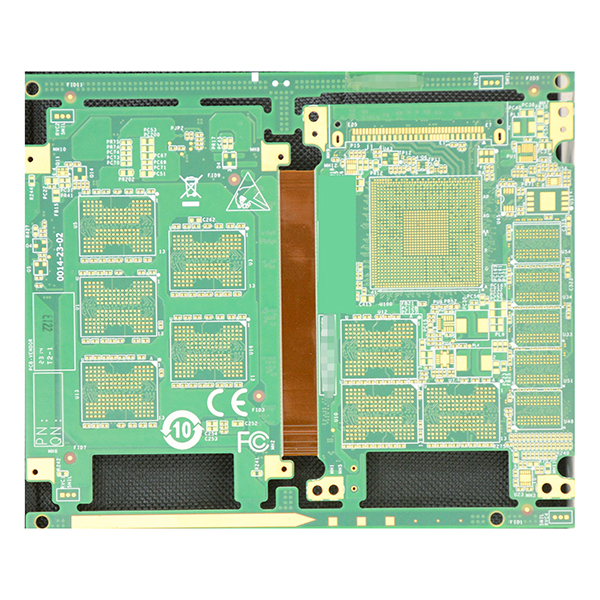
high-density SSD storage printed circuit board fabrication
With the development of AI and high-performance computing, high-density SSD products have emerged to meet the increasing demands for data storage in large-scale cluster servers.
Description
To achieve large-capacity data storage in limited space, this type of SSD storage printed circuit board typically adopts a rigid-flex board design and employs 3D stacking technology during packaging. The number of layers is generally 12 or more, with some structures using 2 to 4 layers of flexible boards. Products with ordinary density are usually folded once, while higher density products may be designed as rigid-flex boards folded twice to further increase storage density and space utilization.
Main Features of SSD Storage Printed Circuit Board Manufacturing
- Adopts a rigid-flex board structure, combining rigid support and flexible connectivity, suitable for complex spatial layouts.
- Supports 3D stacking packaging technology, greatly increasing storage capacity per unit volume.
- Layer counts reach 12 or more, enabling high-density signal routing and multi-channel data transmission.
- The flexible board part uses a 2~4 layer design, supporting multiple bends and improving assembly flexibility and reliability.
- Precision manufacturing process ensures high signal integrity and excellent electrical performance, suitable for high-speed data transmission environments.
- Supports a variety of packaging and interface standards, making it easy to integrate with different controller chips and storage dies.
- The board layer structure, dimensions, and special functions can be customized according to customer requirements, meeting personalized needs in various application scenarios.
Main Applications
- Core storage modules for AI servers and high-performance computing clusters.
- High-density SSD storage devices in data centers.
- Large-capacity storage units for enterprise servers and cloud computing platforms.
- Embedded SSD modules for high-end laptops and ultra-thin portable devices.
- Industrial automation and embedded systems that require high-density, high-reliability storage.
- Other electronic products with stringent requirements on storage capacity, size, and performance.