


 English
  Français
  Tiếng Việt
  Italiano
  Nederlands
  Türkçe
  Svenska
  Polski
  Română
  Latviešu
  한국어
한국어  Русский
  Español
  Deutsch
  Українська
  Português
  العربية
  Indonesian
  Čeština
  Suomi
Suomi  Eesti
Eesti  Български
  Dansk
Dansk  Lietuvių
  Bokmål
  Slovenčina
  Slovenščina
  Ελληνικά
  Magyar
  עברית
עברית 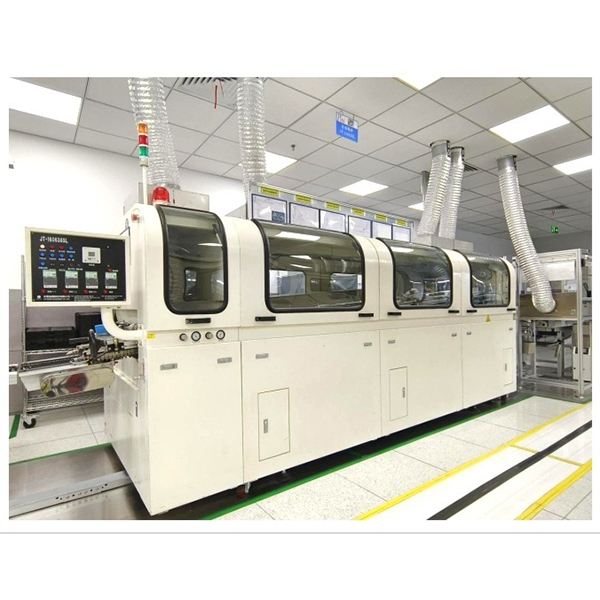
wave soldering for efficient PCB assembly production
Wave soldering reliably connects component leads to PCB pads by passing the component-mounted side of the PCB over a wave of molten solder, making it ideal for mass assembly of through-hole components.
Description
Wave Soldering Overview
Wave soldering is a widely used automated soldering process in the electronics manufacturing industry, mainly for soldering electronic components onto printed circuit boards (PCBs).
Working Principle of Wave Soldering
During the wave soldering process, components are first inserted into the PCB, which then passes through a preheating zone. After preheating, the bottom side of the PCB passes over a wave of molten solder created by a solder pump. The solder wave instantly contacts the leads and pads on the PCB, achieving efficient and uniform soldering. The entire process is highly automated, resulting in stable solder joint quality.
Main Advantages
- High efficiency: Suitable for mass production, greatly improving manufacturing efficiency.
- Reliable soldering quality: Produces beautiful, reliable solder joints, reducing defects such as cold solder or missed soldering.
- High degree of automation: Reduces manual operations, lowers production costs, and enhances product consistency.
- Strong adaptability: Suitable for various types of through-hole components and complex PCB assemblies.
- Environmentally friendly production: Can use lead-free solder, meeting environmental protection requirements.
Application Fields
Wave soldering is widely used in consumer electronics, household appliances, communication equipment, automotive electronics, industrial control, and medical devices. For large-scale PCB assembly, wave soldering is the ideal choice for efficient and high-quality soldering.