


 English
  Français
  Tiếng Việt
  Italiano
  Nederlands
  Türkçe
  Svenska
  Polski
  Română
  Latviešu
  한국어
한국어  Русский
  Español
  Deutsch
  Українська
  Português
  العربية
  Indonesian
  Čeština
  Suomi
Suomi  Eesti
Eesti  Български
  Dansk
Dansk  Lietuvių
  Bokmål
  Slovenčina
  Slovenščina
  Ελληνικά
  Magyar
  עברית
עברית 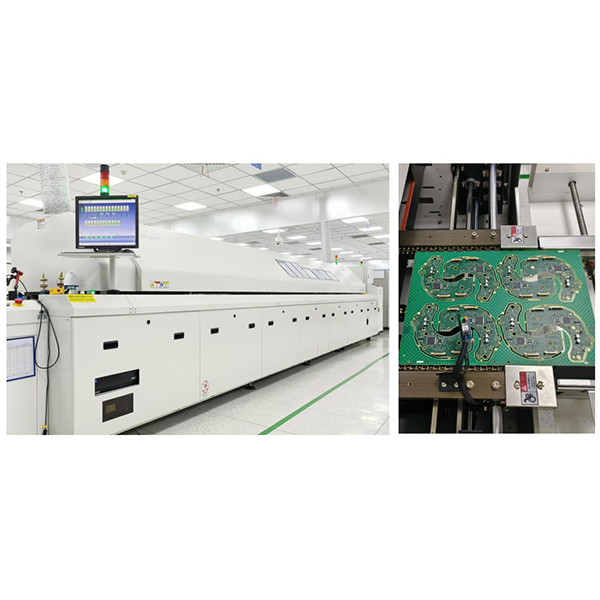
reflow soldering solutions for high-quality PCB assembly
Reflow soldering is a welding process widely used in modern electronics manufacturing, mainly for surface mount technology (SMT) components. By heating under a controlled temperature profile, reflow soldering melts the solder paste, thus achieving reliable connections between components and PCB pads.
Description
Reflow Soldering
Reflow soldering not only improves the automation level of soldering, but also ensures the stability and consistency of soldering quality.
Working Principle
The core principle of reflow soldering is to pass PCBs, which have already had solder paste printed and components mounted, through multiple temperature zones including preheating, soaking, reflow, and cooling. The solder paste melts in the reflow zone, forming strong solder joints and ensuring a reliable connection between electronic components and the PCB. The entire process is fully automated, effectively reducing instability caused by manual operations.
Main Advantages
- High soldering quality: The temperature profile can be precisely controlled, resulting in uniform solder joints and reducing the rate of defects such as cold solder joints and solder bridges.
- High efficiency: Suitable for mass production, with a high degree of automation, saving labor costs.
- Wide applicability: Meets the welding needs of various components and different types of PCBs.
- Environmentally friendly and energy-saving: New reflow soldering equipment is energy-efficient, and some models feature energy recovery systems.
- Good traceability: Equipment supports production data recording, facilitating quality traceability and management.
Applications
Reflow soldering is widely used in consumer electronics, communication devices, automotive electronics, medical devices, and industrial automation. For companies with strict requirements on electronic product performance and reliability, reflow soldering is a key process to ensure product quality.