


 English
  Français
  Tiếng Việt
  Italiano
  Nederlands
  Türkçe
  Svenska
  Polski
  Română
  Latviešu
  한국어
한국어  Русский
  Español
  Deutsch
  Українська
  Português
  العربية
  Indonesian
  Čeština
  Suomi
Suomi  Eesti
Eesti  Български
  Dansk
Dansk  Lietuvių
  Bokmål
  Slovenčina
  Slovenščina
  Ελληνικά
  Magyar
  עברית
עברית 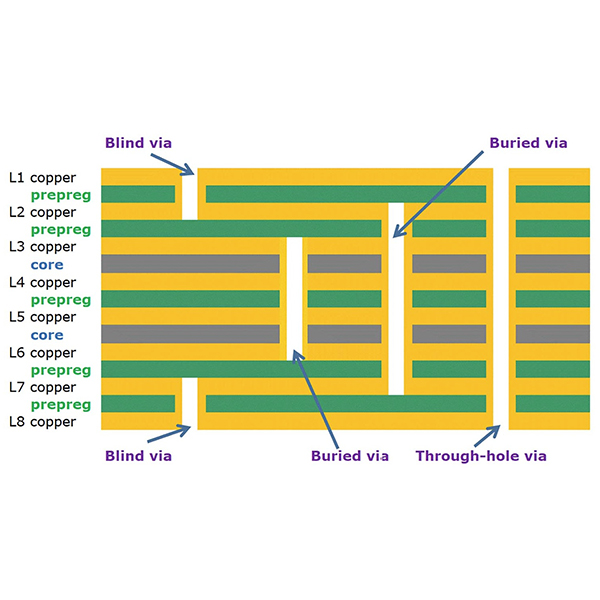
blind vias connect the surface layer and inner layers
Blind vias are drill holes connecting the PCB surface layer to inner layers without penetrating the entire board. They are widely used in multilayer boards for high-density and high-performance electronic products.
Description
Blind vias are a specialized hole structure in multilayer printed circuit boards, primarily used to connect traces between the board’s surface layer (outer layer) and an internal layer. One port of a blind via is located on the PCB’s outer surface, while the other port terminates on an internal layer of the PCB, without penetrating the entire board.
Key Characteristics of Blind Vias
- Connection method: Connects only the surface layer (e.g., Layer 1 or the topmost layer) to an internal layer, without traversing all layers.
- Appearance: Visible from the PCB surface, but the hole does not extend through to the opposite side.
- Manufacturing complexity: More intricate than standard through-holes, requiring layered drilling and plating techniques.
Applications of Blind Vias
- Used in High-Density Interconnect (HDI) boards to increase routing density.
- Suitable for designs requiring multi-layer connections while saving space, such as smartphones, tablets, communication devices, and other high-end electronics.
Advantages of Blind Vias
- Saves PCB space and enhances routing density.
- Effectively shortens signal transmission paths, improving signal integrity.
- Facilitates miniaturization and high-performance designs.