


 English
  Français
  Tiếng Việt
  Italiano
  Nederlands
  Türkçe
  Svenska
  Polski
  Română
  Latviešu
  한국어
한국어  Русский
  Español
  Deutsch
  Українська
  Português
  العربية
  Indonesian
  Čeština
  Suomi
Suomi  Eesti
Eesti  Български
  Dansk
Dansk  Lietuvių
  Bokmål
  Slovenčina
  Slovenščina
  Ελληνικά
  Magyar
  עברית
עברית 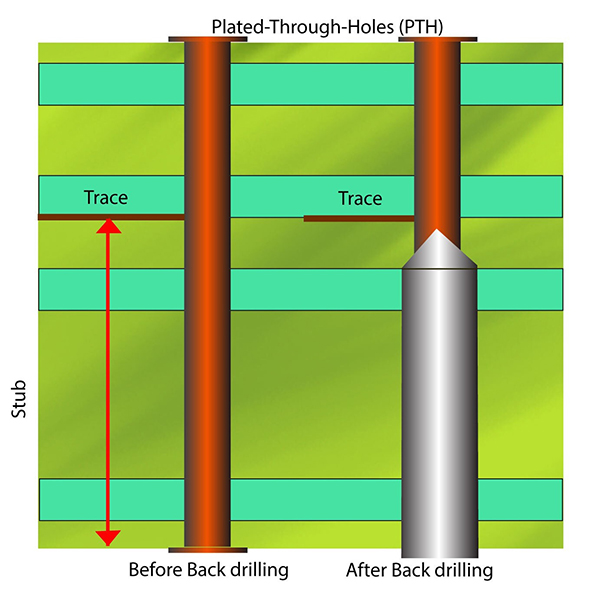
back drilling for removing excess copper pillars from PCB vias
Back drilling is a process that removes excess copper pillars within vias in multilayer PCBs. It is widely used in high-speed, high-frequency electronic product designs to improve signal quality and board-level performance.
Description
Back drilling in circuit boards is a manufacturing process used for multilayer PCBs. Its primary purpose is to remove excess copper within vias in high-speed signal traces, thereby enhancing signal integrity and reducing signal crosstalk and reflections.
Definition of Back Drilling
During PCB manufacturing, mechanical drilling technology is employed to drill from one side of the PCB, removing unwanted conductive copper between certain layers within the via. This process retains only the necessary copper for connection. It effectively eliminates blind copper pillars, preventing signal reflection and loss during high-speed signal transmission.
Typical Applications of Back Drilling
- High-speed, high-definition signal transmission, such as in servers, switches, and data communication fields.
- Multilayer boards, typically 8 layers or more, with increasing prevalence at higher layer counts.
- High-speed PCB designs requiring enhanced signal integrity and EMI performance.
Principle of Back Drilling
- In multilayer boards, vias typically connect different layers. However, when signals need transmission only between specific layers, the remaining portions of the via become excess copper pillars.
- These redundant copper pillars cause signal reflections and crosstalk, degrading high-speed signal quality.
- Back drilling removes the excess copper, retaining only the necessary connection segments to improve signal integrity.
Process Characteristics of Back Drilling
- Back drill holes are typically slightly larger in diameter than the original via.
- Back drilling depth is strictly controlled to prevent penetration into required connection layers.
- Back drilling is generally implemented only at critical locations for high-speed signals.
Advantages of Back Drilling
- Significantly reduces signal reflections and crosstalk.
- Enhances signal integrity and transmission rates.
- Meets circuit design requirements for higher frequencies.