


 English
  Français
  Tiếng Việt
  Italiano
  Nederlands
  Türkçe
  Svenska
  Polski
  Română
  Latviešu
  한국어
한국어  Русский
  Español
  Deutsch
  Українська
  Português
  العربية
  Indonesian
  Čeština
  Suomi
Suomi  Eesti
Eesti  Български
  Dansk
Dansk  Lietuvių
  Bokmål
  Slovenčina
  Slovenščina
  Ελληνικά
  Magyar
  עברית
עברית 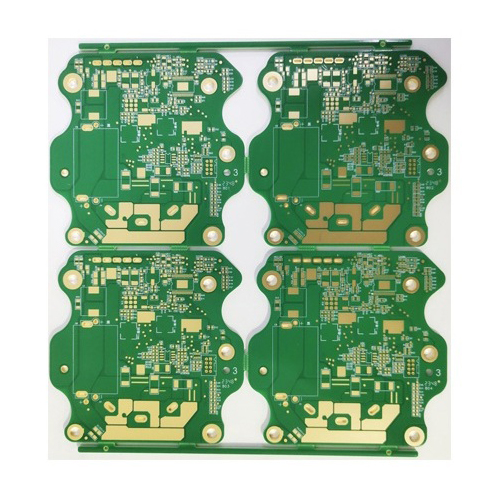
A four-layer printed circuit board with ENIG finish
A 4-layer printed circuit board uses the ENIG process, which aims to form a nickel-gold layer on the circuit surface that is color-stable, bright, smooth, and offers excellent solderability.
Description
ENIG (Electroless Nickel Immersion Gold) Process Overview
The ENIG (Electroless Nickel Immersion Gold) process mainly consists of four stages: pre-treatment (including degreasing, micro-etching, activation, and post-immersion), nickel deposition, gold deposition, and post-treatment (waste gold rinsing, DI water rinsing, and drying).
Main Features of 4-Layer Printed Circuit Boards
- Multi-layer structure: The 4-layer structure provides higher electrical performance and stronger anti-interference capability, making it suitable for complex circuit designs.
- Smooth surface: The ENIG surface is smooth and bright, suitable for fine-pitch components and high-density packages such as BGA.
- Excellent solderability: The gold layer offers excellent solderability, improving soldering quality and assembly reliability.
- Strong oxidation resistance: The nickel-gold layer effectively prevents copper oxidation, extending the PCB’s service life.
- Superior electrical performance: The multi-layer design helps with signal integrity and high-speed signal transmission.
Main Applications of 4-Layer Printed Circuit Boards
- Communication equipment.
- Computer and server motherboards.
- Industrial control systems.
- Medical electronic devices.
- Automotive electronics.
- High-end consumer electronics.