


 English
  Français
  Tiếng Việt
  Italiano
  Nederlands
  Türkçe
  Svenska
  Polski
  Română
  Latviešu
  한국어
한국어  Русский
  Español
  Deutsch
  Українська
  Português
  العربية
  Indonesian
  Čeština
  Suomi
Suomi  Eesti
Eesti  Български
  Dansk
Dansk  Lietuvių
  Bokmål
  Slovenčina
  Slovenščina
  Ελληνικά
  Magyar
  עברית
עברית 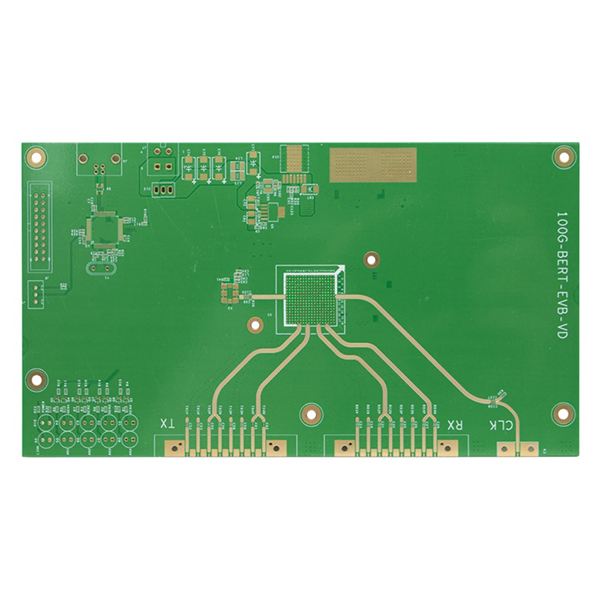
5G signal test PCB fabrication with RO4350B+TU768 process
The 5G signal test printed circuit board is one of the high-frequency PCBs, manufactured using a hybrid pressing process with RO4350B and TU768 high-performance materials, combined with mechanical drilling and ENIG surface treatment.
Description
5G signal test printed circuit boards can achieve a minimum hole diameter of 0.2mm and line width/spacing of up to 100μm, effectively meeting the strict requirements for high precision and high reliability in 5G signal testing. These circuit boards are widely used in high-end electronic testing fields such as 5G signal testing.
Main Features of 5G Signal Test PCB fabrication
- Uses RO4350B+TU768 high-performance substrates to ensure excellent high-frequency characteristics and signal transmission quality.
- Hybrid pressing process enhances the overall performance of the board, suitable for multilayer and complex structure designs.
- Mechanical drilling technology enables high-precision holes as small as 0.2mm, meeting the needs of high-density assembly.
- Surface treatment uses ENIG (Electroless Nickel Immersion Gold) process, improving soldering reliability and oxidation resistance, and extending product lifespan.
- Line width and spacing as fine as 100μm support high-precision circuit designs, ensuring the integrity of 5G high-frequency signals.
- Excellent dimensional stability and mechanical strength ensure the stable operation of the board in various testing environments.
- Customizable number of layers, size, and related parameters according to customer requirements, meeting diversified testing applications.
Main Applications
- Main control boards and related functional modules for 5G signal testing equipment.
- High-frequency, high-speed signal testing instruments and systems.
- Various wireless communication testing platforms and antenna testing modules.
- Test and verification circuit boards for communication base stations and network terminals.
- Other electronic testing fields with strict requirements for high frequency, high precision, and high reliability.