


 English
  Français
  Tiếng Việt
  Italiano
  Nederlands
  Türkçe
  Svenska
  Polski
  Română
  Latviešu
  한국어
한국어  Русский
  Español
  Deutsch
  Українська
  Português
  العربية
  Indonesian
  Čeština
  Suomi
Suomi  Eesti
Eesti  Български
  Dansk
Dansk  Lietuvių
  Bokmål
  Slovenčina
  Slovenščina
  Ελληνικά
  Magyar
  עברית
עברית 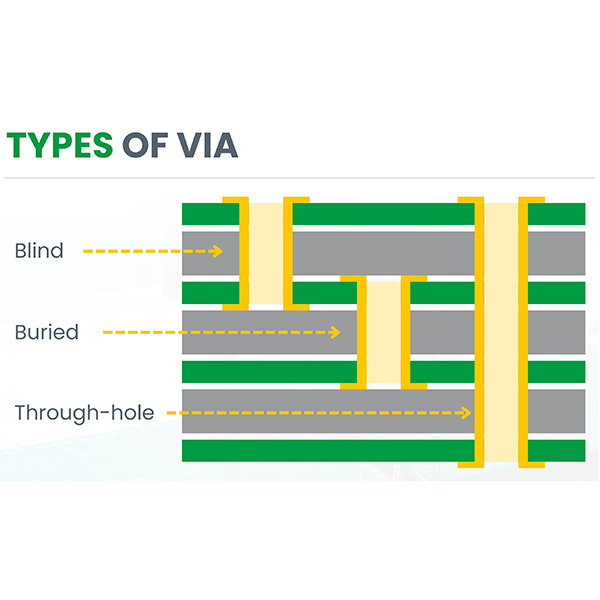
through-hole vias are used to connect all layers of a PCB
through-hole vias are apertures that penetrate all layers of a PCB, with openings at both ends. They are commonly used to connect circuit traces across layers and accommodate component leads, representing a standard hole type in traditional PCB design.
Description
Through-hole vias are a common type of hole structure in printed circuit boards. They refer to holes that penetrate from one side of the PCB to the other, used to connect conductive traces between different layers of the board and also serve as mounting points for component leads.
Key Features
- Penetrates all layers of the PCB, extending from the top layer to the bottom layer, with both ends exposed on the PCB surface. The hole is fully transparent.
- Commonly used to connect conductive traces between different layers of the circuit board and for mounting component leads.
- Manufactured using mature processes, typically involving mechanical drilling or laser drilling followed by metallization (electroplating) to achieve electrical continuity.
Applications
- Establish electrical connections between PCB layers.
- Allow traditional through-hole components (resistors, capacitors, ICs, etc.) to be soldered by inserting pins into the holes.
- Widely used in various circuit board types, especially double-sided and multilayer boards.
Advantages
- Secure connections with stable and reliable electrical performance.
- Mature manufacturing process, low cost, suitable for mass production.
- Facilitates manual assembly and maintenance.