


 English
  Français
  Tiếng Việt
  Italiano
  Nederlands
  Türkçe
  Svenska
  Polski
  Română
  Latviešu
  한국어
한국어  Русский
  Español
  Deutsch
  Українська
  Português
  العربية
  Indonesian
  Čeština
  Suomi
Suomi  Eesti
Eesti  Български
  Dansk
Dansk  Lietuvių
  Bokmål
  Slovenčina
  Slovenščina
  Ελληνικά
  Magyar
  עברית
עברית 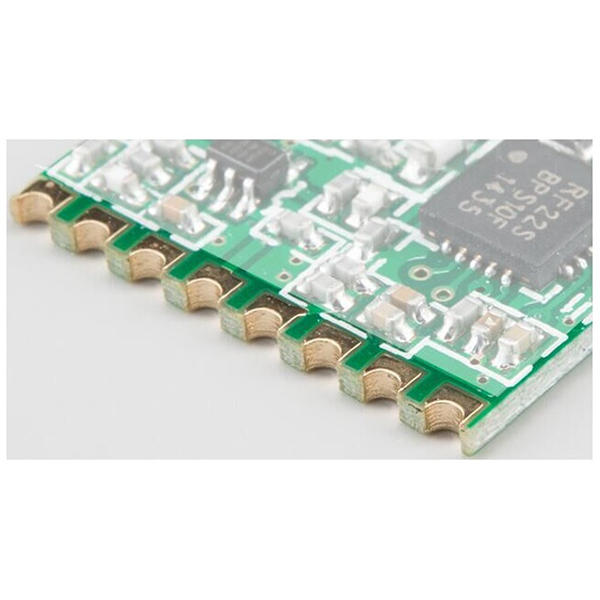
castellated holes and edges on a PCB for WiFi modules
A semi-hole board is a specialized PCB manufacturing process involving semi-circular holes along the board’s edge. Commonly used for assembling small functional modules onto main circuit boards, it represents a prevalent PCB structure in modern modular electronic design.
Description
Castellated holes PCB, also known as edge-half-hole boards, feature a manufacturing process and board type where semi-circular holes, essentially half-via structures, are created along the edges of printed circuit boards. This design results in holes resembling half-moons along the PCB edges, appearing as a row of half-circular holes when viewed from the board’s side.
Key Features
- Structural Characteristics: A half-hole refers to a through-hole drilled along the PCB edge. After cutting, only a semicircle remains, creating a crescent or rivet-hole effect.
- Electrical Connectivity: Half-holes are typically used for electrical connections. They can be soldered like pads, facilitating assembly, splicing, and modular design between small boards and mainboards.
- Common Appearance: A row of regular semicircular holes distributed along the PCB edge, frequently seen in wireless modules, small interface boards, etc.
Applications
- Facilitates soldered assembly of small modules or daughter boards to the main board, such as WiFi, Bluetooth, GSM modules, etc.
- Enables multi-board assembly and simplifies board separation, enhancing assembly and maintenance flexibility.
- Supports standardized interface design, facilitating modular production.
Advantages
- Facilitates plug-in soldering and board-to-board connections, boosting production efficiency.
- Compact structure saves space, ideal for miniaturized electronics.
- Supports mass-produced, standardized module manufacturing and maintenance.