


 English
  Français
  Tiếng Việt
  Italiano
  Nederlands
  Türkçe
  Svenska
  Polski
  Română
  Latviešu
  한국어
한국어  Русский
  Español
  Deutsch
  Українська
  Português
  العربية
  Indonesian
  Čeština
  Suomi
Suomi  Eesti
Eesti  Български
  Dansk
Dansk  Lietuvių
  Bokmål
  Slovenčina
  Slovenščina
  Ελληνικά
  Magyar
  עברית
עברית 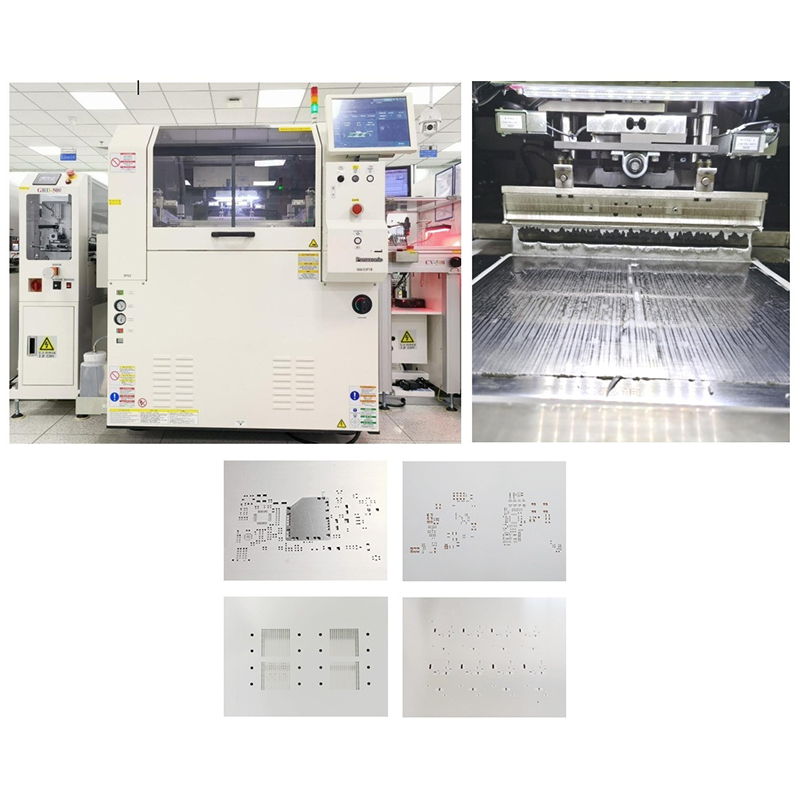
stencil printing for efficient solder paste application
Solder paste printing is a very critical process in Surface Mount Technology (SMT). This process uses a dedicated stencil (template) to accurately apply solder paste to each pad on the printed circuit board (PCB).
Description
Solder Paste Printing
The quality of solder paste printing directly affects the subsequent component placement and solder joint reliability, making it crucial to the overall quality of electronic products.
Working Principle
Solder paste printing typically uses an automatic or manual printer to align the stencil with the PCB. A squeegee is used to evenly spread solder paste across the stencil surface. The solder paste passes through the stencil openings and is accurately deposited onto the PCB pads. After the stencil is removed, the solder paste pattern remains neatly on the PCB, preparing it for component placement and reflow soldering.
Process Steps
- Align the stencil with the PCB to ensure each opening precisely corresponds to a pad.
- Use a squeegee to evenly apply solder paste onto the stencil.
- Solder paste is transferred through the stencil openings to the PCB pads.
- Remove the stencil and inspect the quality of the solder paste printing.
Importance and Advantages
- Ensures even distribution of solder paste, improving solder joint quality.
- Reduces defects such as solder bridging, insufficient solder, and cold solder joints.
- Supports high-density and high-precision electronic product assembly.
- Enhances production efficiency and product reliability.
Application Fields
Solder paste printing is widely used in the assembly of mobile phones, computers, household appliances, automotive electronics, medical devices, and industrial control systems. It is an indispensable and critical step in modern electronics manufacturing.